
Fuel prices have a funny way of impacting basically everything around us. When transportation costs go up, so do the costs of groceries, the cost of shipping and energy discussions feel personal rather than political. That is one reason why alternative fuels still attract the interest of industries and governments around the world. People want solutions that are cleaner, affordable and practical enough to work with existing infrastructure. Ethanol is right in the middle of that conversation.
For many drivers ethanol is something they hardly think about even though they use it regularly. In many countries it’s mixed into gasoline and quietly fuels millions of vehicles every day. But behind that familiar fuel pump label lies a massive global industry interwoven with agriculture, renewable energy, manufacturing and environmental policy.
The ethanol market has been growing steadily, because it has something energy transitions often struggle to offer: compatibility with existing systems. Unlike technologies that require new infrastructure, ethanol can be blended into existing fuel networks relatively easily. That practical edge has kept it in the game even as electric vehicles and other renewable energy technologies grab headlines.
At the same time, the ethanol industry is still complicated. Its advocates say it is a valuable renewable fuel that can help reduce dependence on fossil fuels, while critics cite land use, food production and environmental tradeoffs. The reality, as always, is somewhere in the middle between simple optimism and outright cynicism.
Why Ethanol is So Important in the Energy Sector
Ethanol is produced primarily from plant materials such as corn, sugarcane, and other biomass feedstocks. Ethanol is often touted as a renewable alternative to regular gasoline because the crops used to produce it absorb carbon dioxide as they grow. One of the main reasons ethanol got accepted by the masses is that it is easy to mix with gasoline. In countries such as the United States and Brazil, ethanol blends are already firmly established in the transportation fuel system. There are already many cars operating on the road today that use fuel with ethanol mixtures, a fact which many drivers may not be aware of.
That existing compatibility is quite important. It takes decades and a huge investment to create new energy infrastructure. Ethanol enables governments and fuel suppliers to cut some reliance on fossil fuels without requiring large scale immediate modifications of vehicles or distribution systems.
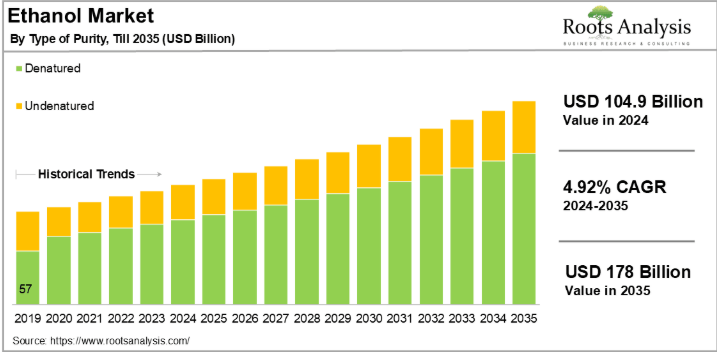
Recently, Roots Analysis came across, and they said that “The global ethanol market size is projected to increase from $104.9 billion in 2024 to $178 billion by 2035, at a CAGR of 4.92% during the forecast period 2024-2035.” The numbers suggest that ethanol remains a major player in the global fuel market, even when faced with competition from newer energy technologies.
There is also an economic angle linked closely to agriculture. In many areas, ethanol production supports farming industries, rural employment and agricultural exports. Ethanol is often an energy strategy and an agricultural policy tool combined in countries with strong farm economies.
Transportation Still the Biggest Driver
Worldwide, transportation still accounts for the biggest share of ethanol demand. Governments also may impose fuel blending mandates. They may require that gasoline suppliers blend a certain amount of ethanol into their fuel to lower vehicle emissions.
Brazil is one of the strongest examples of ethanol integration. Sugarcane based ethanol has become a major part of the country’s transportation system and flex fuel vehicles that can run on varying ethanol blends are extremely common there.
The United States is also still a big producer and consumer, mainly using corn-based ethanol. Though there are ongoing discussions about the environmental efficiency and agricultural impacts of policies that have helped market growth for renewable fuel blending for years. Ethanol has one practical advantage: it burns a little cleaner in some ways than gasoline, helping to cut some emissions. But the bigger environmental impact really depends a lot on how the crops are grown, processed and shipped.
There is also a growing interest in advanced biofuels and second-generation ethanol produced from agricultural waste, crop residues and nonfood biomass sources. These technologies target increasing sustainability and easing pressure on food supply chains. Some energy experts say ethanol is a “bridge fuel” in the transition to cleaner transportation systems. The concept is based on the idea that the world may need a variety of energy solutions that overlap, rather than one perfect substitute for fossil fuels.
Agriculture and Energy Are Closely Interwoven
What makes the ethanol market distinctive is that it is closely tied to agriculture. Fuel production and farming are discussed together in the economic discussion. Ethanol production often benefits when crop yields are strong. Agriculture is not the only sector that can feel the effects of droughts, climate conditions or supply chain disruptions. It creates an odd relationship between weather patterns and energy economics.
Ethanol market conditions are influenced by corn prices, sugar production, land availability and fertilizer costs. In some regions, farmers rely on the need for ethanol as part of their economic security. At the same time, this relationship is controversial. Critics say that using food crops for fuel drives up the price of food or makes inefficient use of land. Supporters say ethanol production produces valuable byproducts for animal feed and agricultural industries.
And agriculture itself is changing rapidly, making the discussion all the more complicated. Precision farming, biotechnology and sustainable crop management practices influence the production and use of feedstock. One ag economist once said ethanol was “where farming and fuel policy collide,” and quite frankly, that’s a pretty good summation of the industry.
Problems of the Ethanol Market
The ethanol market continues to grow steadily, but there are a few key challenges that continue to shape the future of the industry. Environmental issues still remain one of the biggest issues. Ethanol can reduce dependence on fossil fuels, but critics question whether some production methods really provide meaningful carbon reductions when you consider land use, fertilizer application and processing energy.
Some areas also have problems with water use. The production of ethanol can be water intensive, depending on feedstock and production process. Electric vehicles are another long term challenge. As EV adoption increases globally, demand for liquid transportation fuels may slow in some markets over time. But experts disagree on how fast that transition will happen, particularly in the developing world, where combustion engines could continue to be dominant for longer stretches.
Policy uncertainty also impacts the market. Government incentives, a mix of mandates and renewable fuel regulations, are a big factor in ethanol demand. Market conditions can change quickly with political changes. There are also ongoing discussions on food security. Criticism of crop based fuel production tends to increase during periods of rising food prices or food shortages.
But ethanol still has some relevance because the world’s transportation system still relies heavily on liquid fuels in general.
Innovation is Revolutionizing the Industry
One reason the ethanol market keeps changing rather than stagnating is ongoing innovation. Second generation ethanol technologies are attracting a lot of attention because they use agricultural waste materials instead of food crops. Corn stalks, wood chips, sugarcane residue and other biomass sources may someday improve sustainability and reduce environmental concerns associated with traditional feedstocks.
Research is being conducted to improve production efficiencies and reduce water use and emissions in the manufacture of ethanol. Some aviation companies are looking at sustainable aviation fuels made from ethanol as part of wider efforts to cut airline emissions. Heavy transportation sectors are more difficult to electrify and are therefore especially interested in renewable liquid fuels.
The trend is to move away from ethanol as a single product and more toward biofuels within a larger renewable energy system. The ethanol market is still growing, as it finds itself in a pragmatic and somewhat unique position in the global energy transition. It provides a renewable fuel option that can blend into existing transportation systems with relative ease and maintain agricultural economies in many regions.
Demand is primarily driven by transportation, especially in countries with strong fuel blending policies and large agricultural sectors. As well as the traditional production of biofuels, innovation around advanced biofuels and second generation ethanol technologies are helping the market evolve.
Environmental impact, food supply, water use and competition from electric vehicles remain challenges that will shape the future of the industry. But ethanol is still highly relevant in that the transition away from fossil fuels is likely to be a combination of technologies working in concert rather than one immediate replacement.
The ethanol market is particularly interesting because it connects energy, agriculture, economics and sustainability into one integrated system. This sector is one of the few that epitomises the complexity of the global energy transition.