
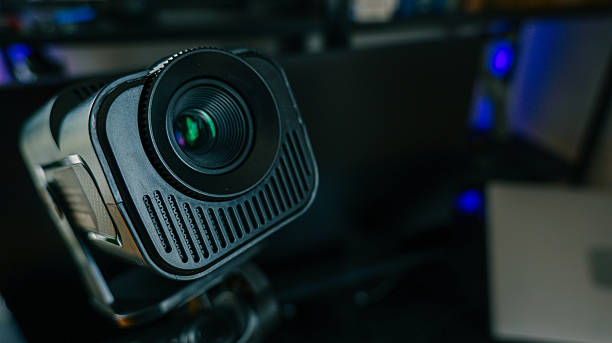
I once counted the signs along a six-block stretch of my city’s main shopping street. Thirty-one storefront signs, eleven window decals, four A-frames on the pavement. By the time I reached the corner, I could recall exactly two of them. One belonged to a bakery with a ridiculous neon croissant. The other wasn’t a sign at all — it was a logo sitting on the wet sidewalk outside a barbershop, thrown there by a small metal box bolted under the awning.
That’s the entire argument for light-based branding in one anecdote. Printed signage competes with every other printed sign on the block. Light competes with almost nothing.
Retailers, event producers and restaurant owners have quietly worked this out over the past few years, which is why projection gear has migrated from theater rigs and nightclubs into ordinary small-business toolkits. Here’s what actually matters if you’re weighing it up: the two main technologies, how to choose between them, and the unglamorous details that decide whether your display reads as premium or as a smudge.
The billboard you already pay rent on
Outdoor advertising is priced by scarcity. A billboard costs money because there are only so many of them. A vinyl banner costs money again every time your promotion changes. Meanwhile the side of your building, the concrete in front of your door, the blank wall above your bar and the ceiling of your lobby all sit completely unused after sunset.
Projection turns those surfaces into inventory you control. No print run, no installer, no three-day wait on artwork. Push a new message for a weekend event, then switch it back Monday morning. Across a year, one decent unit usually costs less than reprinting seasonal banners twice, and unlike a banner it doesn’t fade, curl or flap around in the wind.
Two technologies, two completely different jobs
People lump these together as “projectors.” They aren’t the same product, and choosing the wrong one is the most common and most expensive mistake in this category.
Gobo projection: sharp, static, ruthlessly effective
A gobo is a small etched disc, usually glass, with your logo cut into it. Light passes through, a lens focuses the result, and your mark lands on brick or asphalt with edges clean enough to read from across the street. The serious units are genuinely bright. Models like INNAYA’s gobo projectors push roughly 6,000 lumens and stay legible at around 25 meters in low light, running a 30,000-hour light source inside a weather-sealed housing so they can live outdoors year-round.
Installation is closer to mounting a security light than configuring AV gear. Bracket it, plug it in, twist the focus ring, walk away. That simplicity is the whole point: a display that needs babysitting will not get switched on every night, and a display that isn’t switched on earns nothing.
If you want to compare specific models before committing, this roundup of outdoor gobo projector options is a useful shortcut. It lines up wattage, weather ratings and lens quality side by side instead of making you decode spec sheets one product page at a time.
Holographic fans: movement, depth, and stares
The other route is a spinning LED display, usually sold as a 3d hologram fan. Blades studded with LEDs rotate fast enough that persistence of vision stitches the light into one floating image against a dark background. Products appear to hover in mid-air. Logos assemble themselves out of nothing. Animation is where these earn their money, and animation is why people stop, then film it, then post it.
They scale in a useful way, too. A 16-inch unit sits happily on a reception counter. Larger 39-inch and life-size models handle showroom windows, and modular panels tile into a wall for trade-show booths that make the neighboring stands look like poster board. Most are driven over WiFi from a phone, so refreshing content doesn’t involve a ladder.
Choosing between them: three honest questions
How dark is your surface? Gobo projection needs a reasonably dark, matte, flat canvas. Pale concrete at dusk is close to perfect. A glass facade at noon is hopeless. Hologram fans generate their own light, so they cope far better in bright interiors.
One message, or many? If you’re projecting a single logo night after night, an etched disc is cheaper, tougher and higher resolution than anything animated. If you need rotating promotions, product reveals or motion, the fan wins outright.
Exposed, or under cover? Weather sealing on quality logo projectors is built for rain and cold. Fans are generally an indoor or covered-outdoor proposition — behind glass, or under an awning at minimum.
Placement matters more than wattage
Nearly every disappointing install I’ve seen involved a decent product aimed badly. A few habits fix most of it.
Aim away from competing light. A projected logo three meters from a streetlamp will always lose that fight. Find the shadowed patch and use it instead.
Mount high and angle down. Somewhere around 30 to 45 degrees keeps the image from stretching into a keystoned smear, and stops foot traffic from walking through your beam all evening.
Keep the artwork brutally simple. Single color, bold shapes, no gradients, no tagline set in 9-point type. A gobo is not a brochure. The logos that survive projection are the ones you could recognize as a silhouette.
Respect the neighbors and the local rules. Never aim anything at road traffic or residential windows. Plenty of municipalities treat static, downward-facing projection on your own property as ordinary signage, but a two-minute call before installation is cheaper than a complaint afterward.
The numbers, with appropriate skepticism
Industry roundups regularly credit projection and holographic displays with strong results: recall cited as up to 70% higher than conventional formats, engagement around three times that of flat displays, footfall lifts in the 40s of percent, and roughly double the dwell time at the display itself. Those figures come largely from vendor case studies, so read them as directional rather than gospel.
What I’d trust more is the mechanism underneath them. Motion and unexpected light hijack attention involuntarily — you look before you’ve decided to look. Novelty handles the rest. The honest caveat is that novelty decays. Whichever route you take, budget attention for refreshing the content, not just installing the hardware and forgetting it exists.
Where it pays off fastest
Restaurants and bars use it for atmosphere and menu teasers, projecting onto a wall the diners were already facing. Retailers use sidewalk projection to intercept people who’d otherwise walk straight past a dark window. Trade-show exhibitors reach for hologram fans because booth attention is the entire game and everyone else brought a banner. Car dealers, real estate offices, gyms, venues and wedding planners all lean on the same trick: a surface nobody was looking at suddenly insists on being looked at.
Bottom line
Buy for the surface and the message, not for the spec sheet. If your brand lives on a dark wall or a stretch of sidewalk and your logo rarely changes, get a bright gobo unit and mount it properly. If you need movement, depth and a reason for people to reach for their phones, get a holographic fan. Either way, the real edge isn’t the technology itself. It’s that almost nobody else on your street is using it yet.