
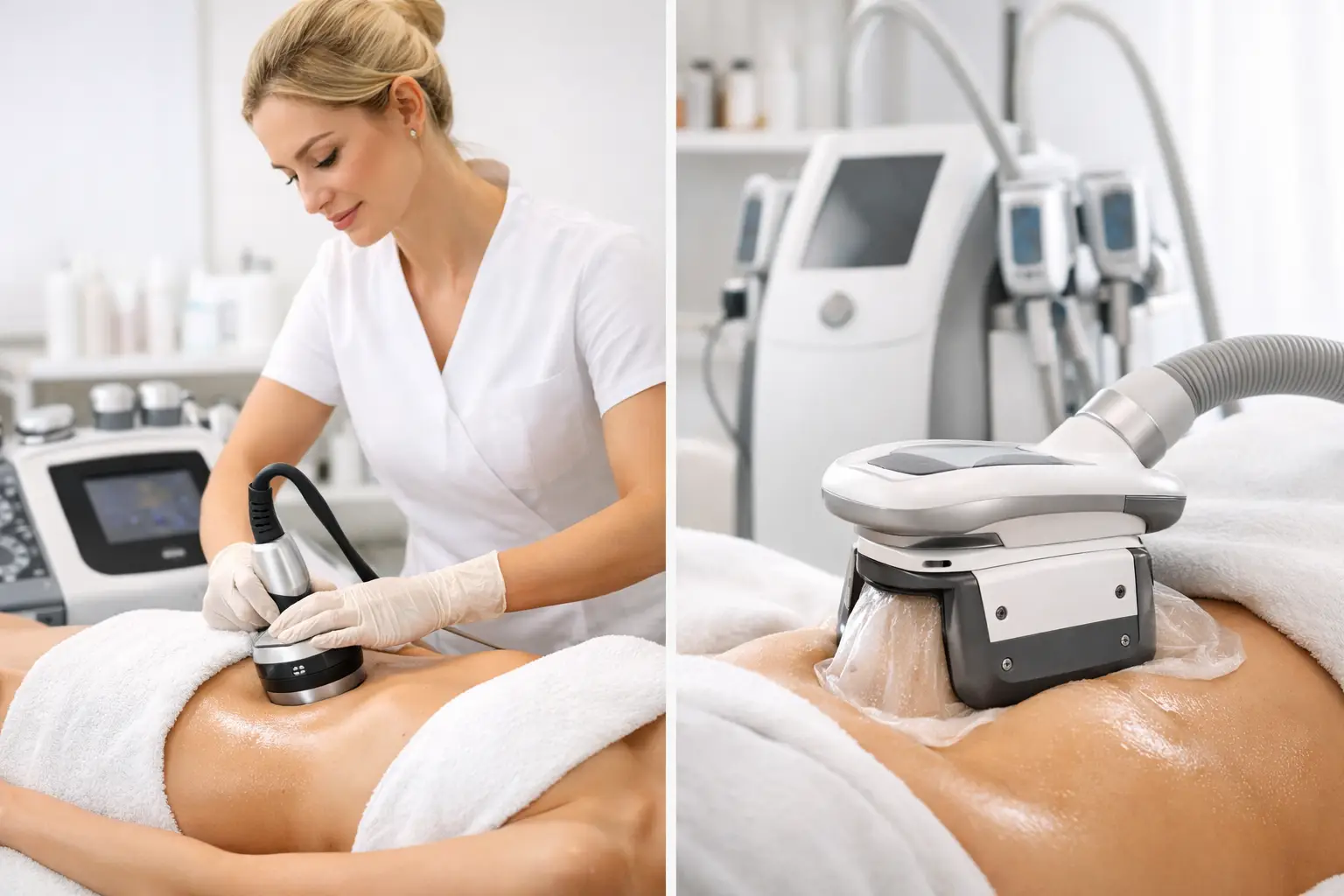
Body sculpting courses are becoming increasingly important for beauty professionals who want to introduce non-invasive body contouring technologies into their treatment menu.
Modern professional body sculpting machines can incorporate several different technologies within one system, including ultrasonic cavitation, radio frequency (RF), vacuum RF and other aesthetic functions. While multi-function equipment can give salons and practitioners considerably more treatment options, it also means there is more to learn.
Choosing the right body sculpting course can therefore be just as important as choosing the right machine.
But body sculpting courses vary significantly. Some focus on general body contouring theory, some provide practical treatment education, while others are specifically designed to teach practitioners how to set up and operate a particular machine.
In this guide, we explain the different types of body sculpting courses available, what to look for before enrolling, the technologies you may encounter and why machine-specific training can be particularly useful when investing in professional body contouring equipment.
What Are Body Sculpting Courses?
Body sculpting courses provide education relating to non-invasive aesthetic body contouring treatments and technologies.
Exactly what you learn depends on the individual course.
Some body sculpting courses provide broad education covering several technologies, while others concentrate on one particular treatment or machine.
Topics may include:
- Ultrasonic cavitation
- 40K cavitation
- 80K cavitation
- Radio frequency
- Multipolar RF
- Vacuum RF
- Machine setup
- Machine controls
- Treatment handpieces
- Contraindications
- Treatment precautions
- Client consultation
- Hygiene
- Machine maintenance
- Professional aftercare
This is why it is important to read the course syllabus before enrolling.
Two courses described as “body sculpting courses” can provide very different forms of education.
Who Are Body Sculpting Courses For?
Body sculpting courses may be relevant to a variety of beauty and aesthetic professionals.
This can include established practitioners who want to expand their treatment menu as well as professionals who have purchased a new machine and need additional guidance on its operation.
For example, an experienced beauty practitioner may already understand professional consultation, hygiene and client care but have recently invested in a new 40K or 80K cavitation machine.
In this situation, machine-specific education can help the practitioner become familiar with the controls, handpieces and operating procedures of their new equipment.
Someone completely new to body contouring may require broader education and potentially practical training in addition to machine-operation guidance.
The right course therefore depends on your existing knowledge, qualifications, insurance requirements and the treatments you intend to provide.
What Do You Learn on Body Sculpting Courses?
There isn’t one universal syllabus used by every training provider.
However, professional body sculpting courses may cover a combination of theory, treatment knowledge and equipment operation.
Body Sculpting Technologies
A course may explain the different technologies commonly found within professional equipment.
Understanding the difference between cavitation, RF and vacuum technologies is particularly important when operating a multi-function machine.
Machine Setup
Machine-focused courses may demonstrate how equipment should be assembled, connected and prepared before use.
Handpiece Identification
A multi-function machine can contain several different handpieces.
Practitioners need to understand which handpiece corresponds to each machine function.
Machine Settings
Training may cover controls such as treatment time, intensity and function selection.
Settings vary between equipment, which is why practitioners should always follow instructions relating to their particular model.
Contraindications and Precautions
Understanding when a treatment should not proceed is an essential part of professional practice.
Cleaning and Maintenance
Correct equipment care helps maintain hygiene and ensures that professional machines are used according to manufacturer guidance.
Online Body Sculpting Courses
Online body sculpting courses have become a convenient option for working beauty professionals.
Online education allows practitioners to study around existing salon appointments and business commitments.
It can be particularly useful for machine-operation education because course materials can be revisited when setting up or using the equipment.
Instead of trying to remember every control after a single demonstration, practitioners may be able to return to the relevant learning material whenever necessary.
Online body sculpting courses may include written lessons, machine guidance, videos, diagrams, assessments or other educational resources depending on the provider.
However, practitioners should understand exactly what type of training they are purchasing.
An online machine-operation course should not automatically be interpreted as an accredited professional qualification.
Body Sculpting Courses for Cavitation Machines
Ultrasonic cavitation is one of the technologies most strongly associated with professional body sculpting.
For this reason, many people searching for body sculpting courses are specifically interested in learning about cavitation equipment.
Professional cavitation machines generally use an ultrasonic handpiece as part of a non-invasive aesthetic body contouring treatment.
Two common machine specifications are 40K and 80K cavitation.
A cavitation-focused course may cover:
- Cavitation machine setup
- Cavitation handpiece identification
- Equipment controls
- Treatment settings
- Treatment areas
- Appropriate treatment medium
- Operating technique
- Treatment precautions
- Contraindications
- Cleaning
- Machine maintenance
The course should correspond with the technology and equipment the practitioner intends to use.
40K Cavitation Body Sculpting Courses
40K cavitation is widely available within professional body contouring equipment.
A 40K body sculpting machine may combine ultrasonic cavitation with several additional technologies.
Depending on the individual model, this can include radio frequency and vacuum RF.
Practitioners using a 40K machine should understand not only the cavitation function but also any additional technologies incorporated into the equipment.
This becomes particularly important with larger multi-function systems.
A machine may have several handpieces, each designed for a different purpose.
Body sculpting courses designed around a specific machine can make it easier to understand how these individual functions fit together.
80K Cavitation Body Sculpting Courses
80K cavitation is another specification available within professional body sculpting equipment.
If you own an 80K cavitation machine, training should relate to the machine and technology you are actually using.
Practitioners should never assume that the settings used on one cavitation machine will automatically be appropriate for another.
Even where two machines provide similar treatment functions, their controls, operating parameters and manufacturer instructions may differ.
Machine-specific guidance should therefore always be followed.
Body Sculpting Courses With Radio Frequency Training
Radio frequency is commonly incorporated into professional body sculpting machines.
A body sculpting course with RF training may explain the purpose and operation of the different radio frequency handpieces supplied with a machine.
Depending on the equipment, separate handpieces may be designed for different applications or treatment areas.
Practitioners should understand which handpiece they are using, how it is controlled and what precautions apply.
This is another area where generic information should not replace the instructions for the specific machine.
Body Sculpting Courses With Vacuum RF
Vacuum RF is another technology found within many professional multi-function body contouring machines.
The combination of suction and RF requires appropriate understanding of the machine controls and handpiece operation.
A course covering vacuum RF may include:
- Identifying the vacuum RF handpiece
- Adjusting applicable settings
- Understanding suction controls
- Appropriate application
- Treatment precautions
- Contraindications
- Cleaning and maintenance
If you intend to purchase a machine incorporating vacuum RF, check whether the body sculpting courses you are considering actually cover this technology.
Body Sculpting Courses for 6-in-1 Machines
A 6-in-1 body sculpting machine combines multiple treatment functions into one piece of professional equipment.
The exact functions vary between machines.
This is an important point.
“6-in-1” does not describe a standard specification used by every manufacturer.
One machine could combine cavitation, RF and vacuum technologies in a particular configuration while another 6-in-1 system could provide a different combination.
If you own a 6-in-1 machine, look for education relevant to the individual functions included with your equipment.
Training for 9-in-1 and 10-in-1 Body Sculpting Machines
Larger 9-in-1 and 10-in-1 body sculpting machines can provide an extensive selection of technologies and handpieces.
For a practitioner, this creates more treatment possibilities but also increases the amount of equipment knowledge required.
Understanding one handpiece does not mean you automatically understand the others.
Each function should be treated according to the relevant training and manufacturer instructions.
This is one of the biggest advantages of machine-specific body sculpting courses.
Instead of providing only generic information, the training can focus on the actual controls and functions of the equipment being used.
Body Sculpting Courses for Beginners
If you are completely new to body contouring, take time to establish exactly what training you require.
A machine-operation course may teach you how to use a particular piece of equipment, but this does not necessarily mean it provides everything required to become a professionally qualified practitioner.
Before enrolling, consider:
- Your existing qualifications
- Previous beauty or aesthetic experience
- Treatments you intend to provide
- Machine you intend to use
- Practical training requirements
- Insurance requirements
Contact your insurer if you are uncertain.
It is much better to establish the requirements before purchasing training and equipment than discover afterwards that additional qualifications are necessary.
Body Sculpting Courses for Existing Beauty Professionals
Existing beauty professionals may have a very different reason for searching for body sculpting courses.
You may already provide professional treatments but want to expand into machine-based body contouring.
Alternatively, you may already provide cavitation and be upgrading to a different machine.
Machine-specific education can be particularly valuable in this situation.
A new machine may introduce:
- Different controls
- Additional handpieces
- Different settings
- New functions
- Different maintenance requirements
Even experienced practitioners should read and follow the instructions supplied for new equipment.
Accredited Body Sculpting Courses vs Machine Courses
When comparing body sculpting courses, pay close attention to how the training is described.
An accredited professional course and a machine-operation course are not the same thing.
Accredited training may involve specific course requirements, theory, assessment and/or practical elements depending on the qualification and accrediting organisation.
Machine-operation training has a different purpose.
It is designed to help practitioners understand the setup and use of specific equipment.
Both forms of education can be valuable, but they should not be confused.
If a course is non-accredited machine training, completing it should not be represented as obtaining an accredited professional qualification.
Body Sculpting Courses and Insurance
Before offering body sculpting treatments commercially, check your insurance requirements.
Different insurers can have different requirements relating to practitioner qualifications and individual treatments.
Your insurer may ask about:
- Existing qualifications
- Additional body sculpting training
- Technologies being used
- Treatment type
- Equipment
- Practical competency
Do not assume that completing any course carrying the words “body sculpting” automatically makes you eligible for insurance.
Provide your insurer with accurate details and obtain confirmation where required.
How to Choose Between Body Sculpting Courses
With so many body sculpting courses available online, comparing them can be difficult.
Instead of choosing purely on price, look at what you are actually receiving.
Check the Course Syllabus
Does the course cover the technologies you want to use?
If you have an 80K cavitation machine, a course focused exclusively on unrelated equipment may offer limited value.
Check Whether It Is Machine Specific
Generic body sculpting theory can be useful, but it may not explain the controls on your individual machine.
Check the Training Status
Is it accredited training, non-accredited training or equipment-operation education?
The provider should make this clear.
Check Your Insurance Requirements
Do this before relying on a course for professional treatment cover.
Check How You Access the Training
If the course is online, establish how the materials are delivered and whether you can refer back to them.
Should You Buy a Body Sculpting Course Before a Machine?
There can be advantages to researching both together.
The equipment you purchase determines which technologies you need to understand.
For example, buying a 40K cavitation and RF system means your training requirements may differ from those of someone purchasing a larger 80K multi-function machine.
Before making either purchase, determine:
- Which treatments you want to offer.
- Which technologies you need.
- Which machine provides those technologies.
- What training is required.
- Whether your insurer has specific requirements.
This creates a much clearer purchasing process than choosing a machine based solely on the number of functions advertised.
How Much Do Body Sculpting Courses Cost?
The cost of body sculpting courses varies according to the type of education provided.
A machine-specific online course may have a very different price from a practical accredited programme involving tutor assessment.
Price alone therefore provides very little information about the course.
Compare the content instead.
Consider what is included, which technologies are covered, whether the course relates to your machine and what type of certification or completion evidence is provided.
Most importantly, make sure you understand what the course qualifies or does not qualify you to do.
Can Body Sculpting Courses Be Completed From Home?
Many online body sculpting courses can be studied remotely.
This can make training much easier for busy beauty professionals who cannot close their salon or travel for every equipment course.
Machine-specific online education can also allow practitioners to learn alongside their equipment.
You can familiarise yourself with the controls, identify the handpieces and refer back to operating guidance when required.
However, remote machine education should not be treated as a substitute for any practical training or qualification required by your insurer.
Body Sculpting Courses and Professional Equipment
Training and equipment should work together.
When purchasing a professional body sculpting machine, look beyond the headline number of functions.
Consider:
- 40K or 80K cavitation
- RF functions
- Vacuum technology
- Number of handpieces
- Machine controls
- Intended treatment applications
- Compliance documentation
- Warranty
- Training availability
- Supplier support
A machine with ten functions is not automatically better than a machine with six.
The most appropriate system is the one containing technologies that fit your business and treatment menu.
Body Sculpting Courses From Glow Beauty Case
Glow Beauty Case LTD supplies professional beauty and aesthetic equipment to UK salons, clinics and practitioners.
Alongside our professional equipment, we provide machine-specific online training courses for selected models.
Our current machine education includes training relating to professional cavitation and body contouring equipment, including selected 40K and 80