
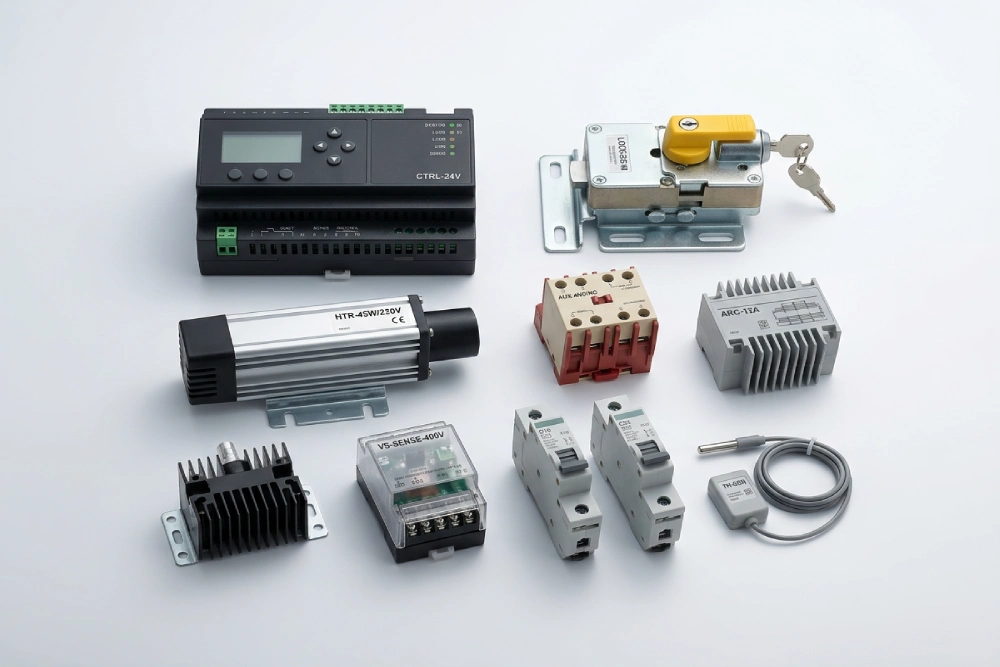
An intelligent enclosure dehumidifier controls moisture inside electrical cabinets through sensing and controlled heating. The system monitors humidity and temperature within the enclosure. A humidity sensor detects changes in moisture levels around electrical components. The control circuit compares sensor readings with preset operating thresholds. When humidity becomes excessive, the controller activates the heating element. Controlled heat raises the internal air temperature and lowers relative humidity. This action helps keep cabinet surfaces above the condensation point. Once conditions return to the target range, heating stops automatically. The cycle starts again when humidity rises beyond the activation threshold. Such operation reduces unnecessary energy consumption during stable conditions. It also limits excessive heat around sensitive electrical equipment. This approach suits switchgear cabinets, control cabinets, distribution boxes, and outdoor electrical enclosures.
Why Moisture Control Matters Inside Electrical Enclosures
Moisture creates several risks for electrical equipment exposed to changing environmental conditions. Condensation occurs when cabinet surfaces reach the surrounding air’s dew point. Water droplets can then form on terminals, circuit boards, connectors, and metal panels. Persistent humidity accelerates corrosion on copper, steel, aluminum, and plated contacts. Corrosion can increase contact resistance and weaken electrical connections over time. Moisture may also reduce insulation resistance across conductive surfaces and circuit paths. Outdoor cabinets face greater risks from rain, sunlight, and nighttime cooling. Indoor cabinets can encounter similar conditions near humid production areas. Enclosure seals can limit external moisture entry but cannot remove internal humidity. Active moisture management therefore provides an additional layer of protection. Combining sealing, drainage, and humidity control supports more stable electrical operation.
How Humidity Sensors Detect Moisture Conditions
Humidity sensors provide the measurements required for automatic moisture management. Many modern systems use capacitive sensing technology to detect water vapor. The sensing material changes its electrical properties as humidity changes. Electronic circuits convert those changes into measurable humidity values. Temperature sensors often work alongside humidity sensors because temperature affects relative humidity. Relative humidity compares current moisture content with maximum vapor capacity at a specific temperature. The same water vapor quantity can produce different readings as temperature changes. Controllers can therefore use both measurements to evaluate cabinet conditions. Sensor accuracy affects activation timing, heating duration, and energy efficiency. Installation position also influences measurement quality inside the enclosure. Sensors near heaters may record warmer conditions than nearby cabinet surfaces. Proper calibration and positioning help provide representative measurements for dependable control.
How Heating Elements Reduce Condensation Risk
Heating elements provide thermal energy for reducing condensation risk inside electrical cabinets. Most cabinet heaters use electrical resistance to generate controlled heat. The heating element needs sufficient output for the enclosure and surrounding conditions. Excessive output can waste energy and raise internal temperatures unnecessarily. Insufficient output may fail during rapid cooling or high humidity periods. Heat distribution also depends on cabinet geometry and natural air movement. Warm air rises while cooler air moves toward lower cabinet areas. Proper heater placement helps distribute thermal energy across colder surfaces. Compact heating elements often include insulation and protective structures. Thermal protection can limit excessive temperatures during abnormal operating conditions. Engineers should consider cabinet volume, ambient climate, internal heat generation, and enclosure materials. Correct capacity and placement support stable internal conditions without excessive thermal stress.
How An Intelligent Enclosure Dehumidifier Controls Humidity
An intelligent enclosure dehumidifier uses control logic to regulate heating cycles automatically. The controller compares sensor readings against predefined humidity thresholds. When humidity exceeds the activation point, the heating circuit starts operating. After conditions improve, the controller stops heating at a lower threshold. This difference creates hysteresis and prevents rapid switching around one value. Frequent switching can increase relay wear and create unstable operating behavior. Some systems also monitor temperature limits for additional thermal protection. Adjustable thresholds allow operators to match control behavior with different cabinet environments. Control circuits may include relays, thermal protection, and operating indicators. These components coordinate sensing and heating without constant manual intervention. Automatic cycling also limits unnecessary power consumption during stable conditions. Reliable operation depends on accurate sensors, suitable thresholds, secure wiring, and matched heating capacity.
What Components Make Up a Cabinet Dehumidification System?
A cabinet humidity control system combines several components with distinct technical functions. Each component contributes to sensing, control, heating, safety, or installation stability.
- Humidity sensor for measuring relative humidity.
- Temperature sensor for monitoring internal thermal conditions.
- Control circuit for processing sensor signals.
- Heating element for producing controlled thermal output.
- Terminal connections for secure electrical wiring.
- Thermal protection for limiting excessive temperatures.
- Mounting structure for stable cabinet installation.
These components must operate together to provide dependable moisture management. Sensors supply environmental data to the control circuit. The controller determines when heating should start or stop. Meanwhile, the heating element supplies the required thermal output. Secure terminals help prevent resistance increases and localized electrical heating. Thermal protection adds another safety layer during abnormal conditions. Stable mounting also prevents vibration from affecting connections. Component compatibility therefore matters when selecting a complete cabinet moisture-control system.
How Sensor Placement Affects Dehumidification Performance
Sensor placement directly affects humidity measurement accuracy inside electrical cabinets. A sensor beside the heating element may detect unusually warm air. That reading may not represent conditions around colder cabinet surfaces. Installing sensors near ventilation openings can create another measurement problem. External airflow may introduce air with different humidity characteristics. A suitable position should represent the cabinet’s general internal environment. Installers should avoid direct heat radiation and strong airflow paths. Cooler cabinet walls and cable entry areas may deserve particular attention. Wiring should also remain protected from heat and electrical interference. Proper positioning allows the controller to react to actual environmental changes. Accurate sensing supports better condensation prevention and efficient heating cycles. Good installation therefore contributes directly to long-term moisture protection and system reliability.
How Moisture Control Protects Electrical Components
Moisture can affect electrical components through corrosion, insulation degradation, and conductive leakage. Copper terminals may develop oxidation that increases contact resistance. Steel hardware can corrode when humidity remains high for extended periods. Circuit boards face additional risks because moisture can create unwanted conductive paths. Repeated condensation may also damage protective coatings and sensitive connections. An intelligent enclosure dehumidifier reduces these environmental stresses through controlled humidity management. Stable conditions can support longer service life for relays, contactors, terminals, sensors, and control modules. Moisture control should complement enclosure seals and protected cable entries. Designers should also consider drainage, ingress protection, and suitable cabinet construction. No single component can compensate for poor environmental protection. A coordinated strategy provides stronger reliability across demanding electrical installations. Proper humidity management can reduce moisture-related maintenance and operational interruptions.
How to Select the Right Dehumidification Capacity
Selecting suitable heating capacity requires more than checking cabinet dimensions. Engineers should evaluate enclosure volume, ambient humidity, temperature changes, and condensation risk. Cabinet materials also affect thermal behavior because metals transfer heat efficiently. Outdoor enclosures may experience faster temperature changes than indoor installations. Internal equipment creates additional heat that can influence heater requirements. Power supplies, drives, transformers, and other components may change internal temperatures considerably. Enclosure sealing affects how quickly humid external air enters the cabinet. Buyers should compare heating output, temperature range, humidity thresholds, sensor accuracy, and rated voltage. Excessive heating can waste energy and increase thermal stress. Insufficient heating may fail during severe environmental conditions. Capacity selection should therefore reflect the complete operating environment. Balanced specifications provide more dependable moisture protection than cabinet volume alone.
Where Are Intelligent Cabinet Dehumidifiers Commonly Used?
Cabinet humidity control supports electrical systems exposed to changing temperature and moisture conditions. Switchgear cabinets often face condensation during seasonal weather changes. Control cabinets may experience high humidity in factories and processing facilities. Outdoor distribution boxes encounter rain, solar heating, nighttime cooling, and atmospheric moisture. Automation cabinets also benefit from stable conditions around sensitive electronic controls. Renewable energy systems, railway equipment, telecommunications cabinets, and industrial panels may have similar requirements. Frequent cabinet access can increase humidity because door openings introduce external air. Installation conditions therefore influence required control strategies and heating capacity. Designers should consider local climate, cabinet construction, internal equipment, and maintenance access. Different environments may require different operating thresholds and thermal outputs. Matching moisture control with actual conditions improves equipment reliability. A standardized configuration should not automatically apply to every electrical enclosure.
How to Maintain and Evaluate Cabinet Dehumidification Systems
Routine maintenance helps preserve stable moisture control throughout equipment service life. Technicians should inspect sensors and verify readings against actual cabinet conditions. Electrical terminals need periodic checks for looseness, discoloration, or abnormal heating. Heating elements should remain clean and free from materials that restrict heat transfer. Dust accumulation can reduce thermal performance and limit natural air movement. Mounting hardware also requires inspection because vibration can loosen mechanical connections. Technicians can compare sensor readings with a calibrated reference instrument during maintenance. Significant differences may indicate sensor aging or installation problems. Door seals and cable entries should receive attention because external moisture can bypass internal control. Buyers should evaluate sensing accuracy, heating output, electrical protection, mounting compatibility, and service requirements. Technical performance should remain the primary purchasing consideration. Proper maintenance supports predictable operation across changing environmental conditions.
FAQ
Can An Intelligent Enclosure Dehumidifier Prevent All Condensation?
No moisture-control system can eliminate condensation under every environmental condition. Condensation depends on humidity, temperature, surface temperature, and enclosure construction. Proper heating can reduce risk by keeping critical surfaces above the dew point. However, damaged seals or water entry can still create moisture problems. Extreme temperature changes may also challenge equipment with insufficient thermal capacity. Cabinet design therefore remains essential for complete environmental protection. Operators should inspect door gaskets, cable entries, ventilation points, and drainage arrangements regularly. Sensor placement also matters because inaccurate readings can delay heating responses. Correct heating capacity and suitable thresholds improve overall performance. The strongest protection combines active moisture control with suitable enclosure construction. Regular maintenance helps preserve performance as environmental conditions change.
What Humidity Level Should an Electrical Enclosure Maintain?
No universal humidity value suits every electrical enclosure or operating environment. The correct setting depends on equipment sensitivity, temperature, construction, and condensation risk. Relative humidity alone cannot fully predict condensation because surface temperature also matters. Dew point provides useful information when evaluating potential water formation. Sensitive electronic systems may require tighter environmental control than simple terminal cabinets. Outdoor installations often need greater attention because temperatures can change quickly. Operators should follow equipment specifications when setting humidity thresholds. The goal should remain condensation prevention rather than achieving extremely low humidity. Excessive heating can waste energy and raise cabinet temperatures unnecessarily. Stable conditions usually provide a better balance between protection and efficiency. Regular monitoring can confirm whether the selected threshold remains suitable.
Where Should a Cabinet Dehumidifier Be Installed?
Installation should support effective heat distribution without exposing sensitive components to excessive temperatures. The heating element needs adequate clearance from wiring and insulation. Lower cabinet positions may support natural convection as warm air rises. However, cabinet geometry can require another position for better thermal distribution. Sensors should remain away from direct heat radiation and strong airflow. Adequate spacing helps reduce localized hot spots around heated components. Wiring should remain secure and follow appropriate electrical installation practices. Technicians should maintain access for inspection and servicing. The mounting surface must provide enough mechanical stability for long-term operation. Correct placement helps warm air reach colder cabinet surfaces more evenly. Installation should follow specified clearances, orientation, and electrical requirements.