
Medical procedures, even routine ones, improve over time. Better tools, better training, better understanding of what actually works and what introduces unnecessary risk. The history of ear wax removal is a clear example of this kind of quiet but meaningful clinical progress. What was once a fairly blunt, water-based procedure has been transformed by a method that offers a level of precision, safety, and patient comfort that the previous generation of treatments simply could not match.
That method is microsuction, and for anyone dealing with blocked ears in London, understanding why it represents such a significant advance in ear care is genuinely worthwhile.
Ear Wax: A Misunderstood and Underestimated Problem
Ear wax, clinically known as cerumen, is one of those bodily substances that people find awkward to discuss and quick to dismiss. Yet impacted ear wax is one of the most common and consistently underaddressed health issues in the UK, affecting millions of adults every year and contributing to symptoms that range from mildly irritating to genuinely disabling.
The wax itself is not the problem. Produced continuously by glands in the outer ear canal, it plays a vital protective role, trapping airborne particles, bacteria, and debris before they can reach the eardrum. It also maintains the slightly acidic environment that discourages bacterial and fungal growth in the canal.
In most people, the ear manages its own wax production effectively. Old wax migrates outward naturally through a process called epithelial migration, the gradual outward movement of skin cells from the eardrum toward the ear opening, assisted by jaw movement during speaking and chewing. The wax eventually dries and falls away without any intervention.
But for a significant subset of the population, this process breaks down. Narrow or curved ear canals slow outward migration. Hearing aid and earphone use physically block the path that wax would otherwise take. Some individuals simply produce more wax than their ears can clear. Older adults experience progressively drier, less mobile wax as natural migration slows with age. And widespread use of cotton buds, despite consistent advice from audiologists to the contrary, compacts soft wax into hard impactions that the ear has no mechanism to resolve on its own.
The result is cerumen impaction: a clinical condition with real, measurable symptoms and a clear need for professional intervention.
The Limitations of Traditional Approaches
For most of the twentieth century, the standard clinical response to ear wax build-up was ear syringing. A large metal syringe was used to direct a forceful stream of warm water into the ear canal with the aim of dislodging and flushing out the wax. It worked in straightforward cases, but the approach was crude by modern standards.
Ear syringing carried a meaningful risk of perforating the tympanic membrane, causing otitis externa from water retained in the canal, and damaging the delicate skin lining of the ear canal wall through pressure or contact. Patients with existing ear conditions, perforations, or prior surgery could not safely undergo the procedure at all. And because the clinician was working without any visual guidance inside the canal during the procedure, the entire process relied on feel, experience, and inference rather than direct observation.
Ear irrigation, the regulated electronic successor to syringing, reduced some of these risks by controlling the pressure and temperature of the water more precisely. But it retained the same fundamental limitation: no direct visual guidance during treatment. The clinician could not see what was happening inside the ear canal as the procedure took place. For a treatment targeting a small, delicate anatomical structure in close proximity to the eardrum, that is a significant constraint.
How Microsuction Changed the Standard of Care
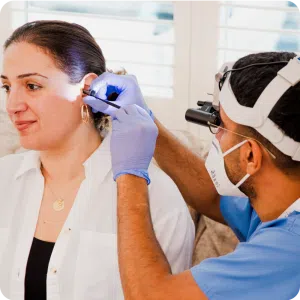
Microsuction addresses the core limitation of its predecessors directly. Rather than introducing water into the ear canal, it uses a fine, calibrated suction device operated under continuous direct visual magnification. The clinician uses a binocular operating microscope or specialist ENT loupes throughout the entire procedure, maintaining a clear, illuminated view of the ear canal, the wax, and its relationship to the eardrum at every moment.
This changes the procedure fundamentally. The clinician is not working by inference or educated guesswork. They are observing directly and responding in real time to exactly what they see. The suction tip’s position can be adjusted moment by moment. The rate of suction can be modified. Any unexpected finding, a previously unknown perforation, an unusual anatomical feature, can be identified and responded to immediately rather than discovered after the fact.
The clinical advantages that follow from this are substantial:
Significantly expanded patient suitability. Because microsuction uses no water and involves no pressure applied to the canal wall, it is safe for patients who cannot undergo irrigation: those with perforated eardrums, prior ear surgery, mastoid cavities, grommets, and chronic ear infections. The contraindication profile is dramatically smaller.
Greater procedural precision. The magnification provided by the operating microscope allows the clinician to see and work with a degree of detail impossible in the pre-microsuction era of ear care.
Immediate treatment without preparation. Unlike irrigation, which typically requires several days of pre-treatment with softening drops to work effectively on harder wax, microsuction can be performed in most cases without prior preparation. Assessment and treatment happen in the same appointment.
Comfort and speed. Most patients report experiencing only a mild whooshing sound and gentle vibration during the procedure. The treatment for both ears typically takes between 15 and 30 minutes. Pain is not a common feature when the procedure is carried out by an experienced clinician.
For anyone looking for professional ear wax removal London services, the clinical case for microsuction over any water-based alternative is clear and well-supported by audiological practice.
The London Private Ear Care Landscape
The increasing availability and adoption of microsuction in London has been accelerated by a significant change in NHS provision. Following guidance from NHS England, the majority of GP practices across England have withdrawn routine ear wax removal services, citing resource constraints and clinical prioritisation decisions.
The effect has been a substantial increase in demand for private ear care services. Patients who previously received treatment through their GP now need to navigate a private market with varying standards of clinical quality, equipment investment, and professional oversight.
Understanding what distinguishes a high-quality microsuction clinic London wide from a less rigorous provider is therefore practical and important knowledge for any patient.
Clinician registration and credentials. Microsuction should only be performed by audiologists registered with the Health and Care Professions Council (HCPC), specialist ear care nurses, or ENT surgeons and consultants. A reputable clinic will be fully transparent about the professional registration of its clinical team, both on its website and when asked directly.
Equipment quality and specification. The procedure requires a medical-grade regulated suction device paired with a binocular operating microscope or quality ENT loupes. This equipment is not inexpensive, and its presence is a reliable indicator of a clinic operating to genuine clinical standards. Clinics offering video otoscopy, which allows patients to view their own ear canal on a screen before and after treatment, are demonstrating an additional level of clinical transparency.
Pre-treatment assessment as standard. Every appointment should begin with an otoscopic examination of both ears and a relevant medical history before any treatment is undertaken. This step is clinically essential: it identifies contraindications, confirms the diagnosis, and determines the appropriate treatment method. Any provider that skips or abbreviates it is taking shortcuts that matter.
Transparent and reasonable pricing. Standard microsuction for both ears in London is typically priced between PS55 and PS90. This reflects appropriate clinical infrastructure, professional staffing, and the thoroughness of a proper appointment. Significantly lower pricing may reflect compromises in one or more of these areas.
What a Quality Appointment Looks Like in Practice
The patient experience at a well-run microsuction clinic follows a clear and reassuring structure.
The appointment begins with a consultation covering symptoms, duration, and medical history. Both ears are examined with an otoscope to assess the extent and nature of the wax build-up and to confirm that microsuction is the most appropriate approach.
During the procedure, the patient is seated comfortably while the clinician uses a small speculum to gently hold the ear canal open. The suction device is introduced under magnification and used to carefully extract the wax. The whole process for both ears typically takes between 15 and 30 minutes.
Following treatment, both ears are re-examined to confirm the canals have been successfully cleared, and the clinician provides relevant aftercare guidance. Many patients note an immediate and significant improvement in hearing clarity upon leaving the clinic, particularly those who have been living with a significant blockage for some time.
Sustaining Ear Health After Treatment
For patients prone to recurring wax build-up, the period after treatment is a good time to establish habits that slow the rate of future accumulation.
Regular use of olive oil or almond oil drops, two to three drops in each ear two to three times per week, maintains wax softness and supports the natural outward migration process. This is particularly relevant for hearing aid users, earphone users, and older adults, all of whom are at elevated risk of recurrence.
Avoiding cotton buds entirely remains the single most impactful preventative measure for most people. The mechanical action of a cotton bud compacts wax rather than removing it, and the habit is responsible for a significant proportion of the impacted wax cases presenting at private ear clinics.
Patients who find themselves returning for treatment every two to three months are worth discussing a planned maintenance schedule with their clinician, rather than waiting for symptoms to become acute between reactive appointments.
A Procedure Worth Understanding
Microsuction may not carry the headline-grabbing profile of robotic surgery or regenerative medicine, but the clinical progress it represents is genuine and meaningful. Safer, more precise, more comfortable, and more broadly applicable than the methods it has replaced, it offers a significantly better experience for patients and a significantly more defensible standard of care for clinicians.
For anyone in London dealing with blocked ears, reduced hearing, or persistent tinnitus, finding a qualified provider offering microsuction London services is the most direct route to a fast and reliable resolution. Auris Ear Care delivers specialist microsuction across London through experienced, registered clinicians, with appointments available to fit around your schedule.
Good ear care is quieter work than it used to be. That is precisely the point.